

Early Years Funding 2026–27: Everything UK Nurseries and Childcare Providers Need to Know

If April 2026 has crept up on you, you are not alone. This year, the start of the new financial year brings a particularly dense cluster of changes to early years funding — all arriving at once and all with real implications for your cash flow, your billing, and your team's pay packets.
The Government has confirmed a record £9.5 billion investment in early years for 2026–27. That sounds reassuring. But the fine print is more complicated: new hourly funding rates, a minimum wage increase that runs ahead of the funding uplift for younger staff, a new mandatory pass-through rule for local authorities, a shift to termly headcounts for three and four-year-olds, and a significant rise to the Early Years Pupil Premium.
This guide breaks all of it down — clearly, section by section — so you know exactly what has changed, what it means in practice, and what steps to take now. We’ve also included a practical checklist and some guidance on how good childcare management software can take the strain out of funding administration.
🗓️ Key dates at a glance
- 1 April 2026 — New DfE statutory guidance takes effect
- 1 April 2026 — New hourly funding rates for 2026–27 begin
- 1 April 2026 — National Living Wage increases to £12.71/hr
- 1 April 2026 — LA pass-through minimum rises from 96% to 97%
- April 2026 (Summer term) — Termly headcount model now applies to 3 & 4-year-olds
- October 2026 — LAs must begin paying providers monthly on request
1. The New Hourly Funding Rates for 2026–27
On 15 December 2025, the Department for Education announced the local authority hourly funding rates for the 2026–27 financial year. The Government described the increases as “above inflation”, and for three and four-year-olds in particular, the uplift is the strongest in several years.
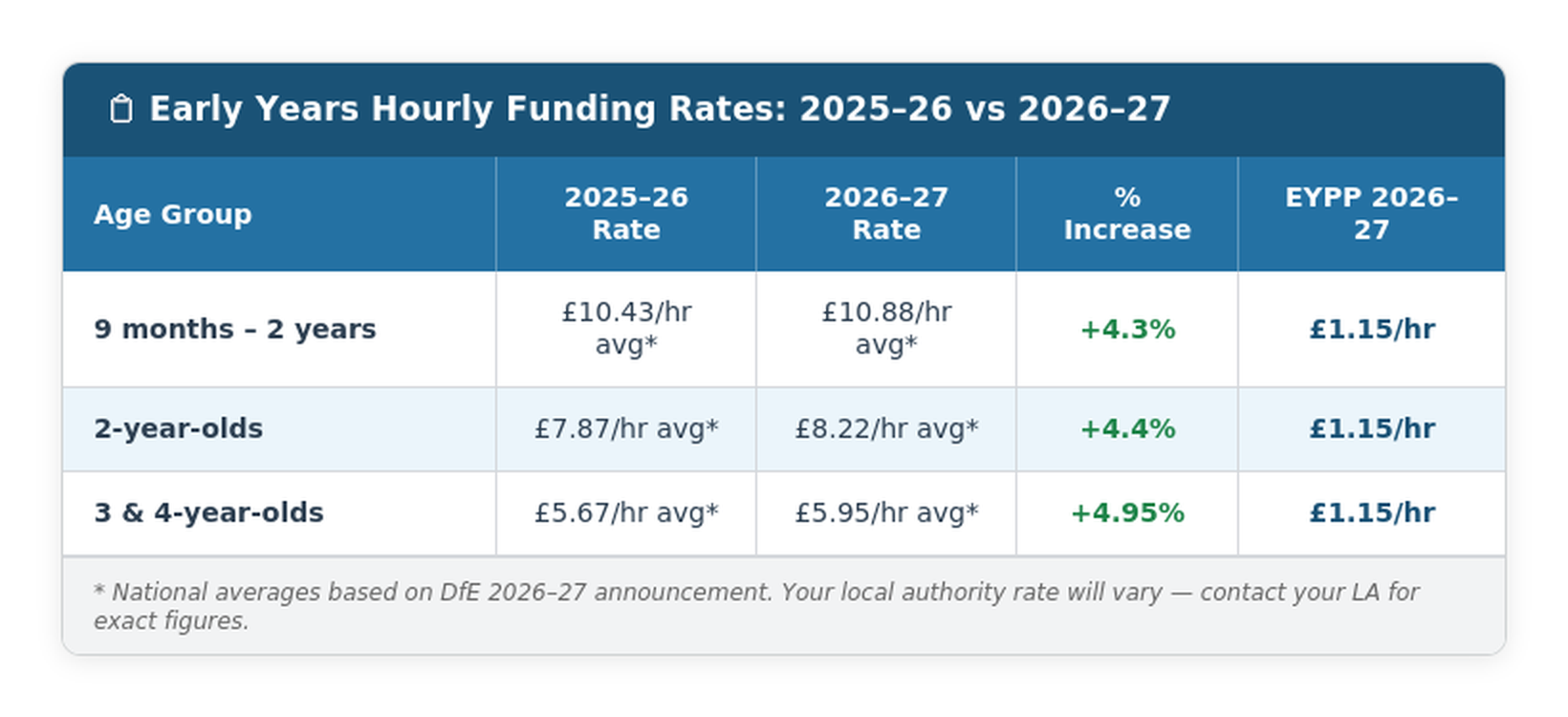
What this means in practice: For a typical full-time-equivalent nursery place, the additional income from the rate increase will be meaningful — but it will not fully offset cost pressures for all settings, particularly where a higher proportion of your staff are under 21 and therefore benefiting from a steeper minimum wage rise than the funding uplift covers.
The NDNA has noted that while the above-inflation increases will help most providers pay the statutory wage uplift for the majority of practitioners, the increases for younger minimum wage bands outpace the funding rate rises — creating a persistent squeeze for settings with younger workforce profiles.
Don’t assume your LA will automatically pass on the full increase
Local authorities set their own local rates within the national formula framework. While they are now required to pass through at least 97% of their allocation, the distribution of that funding across settings can still vary significantly. Contact your LA directly to confirm your expected rate for the summer term and set a calendar reminder to revisit at each term start.
2. The New 97% Pass-Through Rule — What It Means for Your Setting
From April 2026, local authorities are required to pass through a minimum of 97% of their early years funding allocation directly to providers. This is an increase from the previous 96% requirement.
The change is designed to ensure that more of the £9.5 billion government investment in early years actually reaches the settings delivering care — rather than being retained by local authorities for “central services” such as quality assurance, training coordination, and administration.
What “pass-through” means in plain English
If your local authority receives £10 million in early years funding, it must now distribute at least £9.7 million of that directly to providers like you. Under the previous rule, it could retain up to £400,000 for its own services; now the maximum it can retain is £300,000.
For providers, this should in theory mean a slightly higher proportion of the national funding rate lands in your bank account. However, the exact impact depends entirely on how your LA has historically operated — some LAs were already well above the 96% threshold, so the change will be minimal in practice. Others may see a meaningful improvement.
What to do
- Contact your LA’s early years funding team and ask for written confirmation of your 2026–27 base rate and any supplements (such as deprivation or SEND inclusion funding) you are entitled to.
- Check that your indicative budget for the year has been issued — LAs are required to provide this at the start of each financial year.
- If you are part of a provider group or association such as NDNA or PACEY, use their resources to benchmark your LA’s local rates against regional averages.
3. National Minimum Wage Increases from April 2026
April 2026 also brings the latest round of National Minimum and Living Wage increases, confirmed following the Low Pay Commission’s recommendations. For nurseries and childcare settings — where wages typically represent 70–80% of total operating costs — these increases are one of the most significant financial pressures of the year.
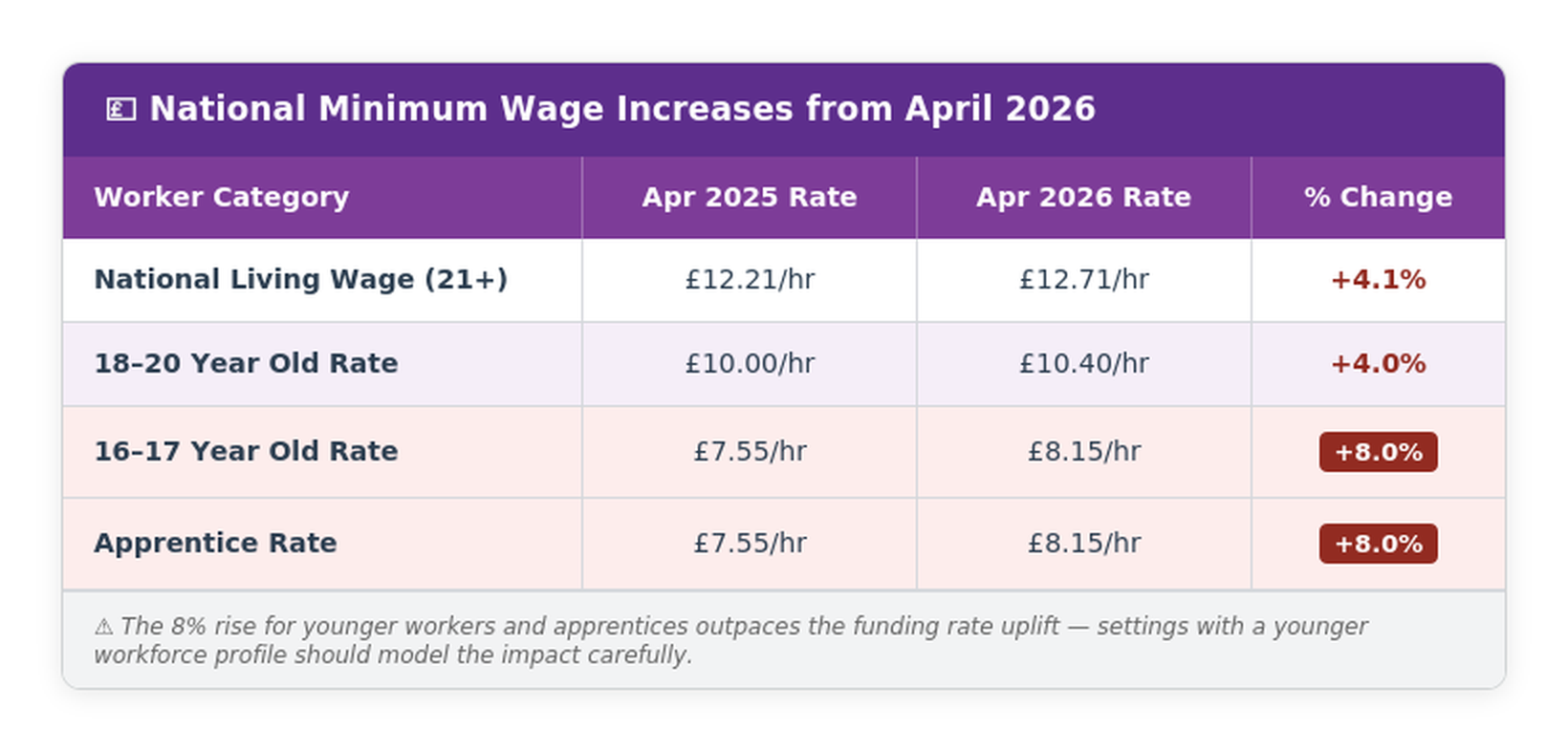
The headline National Living Wage for workers aged 21 and over rises from £12.21 to £12.71 per hour — a 4.1% increase that broadly aligns with the funding rate uplift for three and four-year-olds. However, the rates for younger workers rise by a much steeper 8%, which creates a particular challenge for settings with a significant proportion of younger or apprentice staff.
Calculating the real impact on your wage bill
The precise impact depends on your staffing profile and hours. As a working illustration, a setting with 10 full-time equivalent staff on the National Living Wage, each working 37.5 hours per week across 50 working weeks, would see their annual wage bill for those staff alone increase by approximately £9,375 just from the NLW rise. Factor in the pension and National Insurance implications and the true cost of the 2026 wage changes across a typical nursery runs into the tens of thousands.
Importantly, many providers will find that the funding rate increase covers the majority of this uplift for staff aged 21 and over — but not fully, and not for younger workers. Building a clear financial model for the year ahead, using your actual headcount and wage bands, is an essential step before you can forecast profitability for 2026–27.
Watch out: the NI change from April 2025 still bites
Don’t forget that the National Insurance contributions increase introduced in April 2025 is still in effect. Unlike maintained schools, private and voluntary nurseries received no additional government funding to offset the NI rise. If this created a shortfall in 2025–26, the higher funding rates in 2026–27 go some way towards addressing it — but not entirely. Factor this into your annual budget review.
4. The Switch to Termly Headcounts for 3 & 4-Year-Olds
One of the more significant operational changes in 2026–27 is the move to a termly funding model for three and four-year-old entitlements. Previously, the DfE conducted termly headcounts for under-threes, but used a different counting approach for older children. From the summer term 2026 onwards, a consistent termly headcount approach applies across all age groups.
Why this matters
The termly model means that your funding for any given term is calculated based on the actual number of funded children on your roll at the start of that term — not an annual projection. In practical terms, this creates more accurate funding allocations and should reduce over- or under-payments that previously required reconciliation at year-end.
However, it also means you will now need to submit more returns to your local authority during the year. Where previously you may have made two formal returns for three and four-year-olds, you will now make three — one per term. This increases your admin burden slightly, and accuracy becomes even more important: errors in your return affect your funding for the entire term.
What to do
- Update your internal calendar to include all three headcount submission deadlines for 2026–27. Your local authority should have communicated these dates — if not, contact them proactively.
- Audit your registration and attendance records ahead of each headcount date. Children who are registered but not attending will need to be handled carefully, as funding is tied to actual attendance patterns.
- If you use childcare management software, check that your system can generate headcount-ready reports in the format your LA requires. Doing this manually for 50+ children three times a year is a significant time investment.
How Cheqdin helps with headcount returns
Cheqdin’s reporting tools allow you to generate attendance and enrolment summaries at the click of a button — broken down by age group, funding status, and session type. Rather than manually cross-referencing paper registers against your funded children list before each headcount, you can pull a clean, accurate report directly from your live data. This is one of those “quiet wins” that saves several hours per term and significantly reduces the risk of submission errors.
5. Early Years Pupil Premium: A 15% Rise to £1.15 Per Hour
The Early Years Pupil Premium (EYPP) receives one of its most significant uplifts in years for 2026–27, rising by 15% from approximately £1.00 to £1.15 per hour. This translates to up to £655 per eligible child per year — a meaningful increase that reflects growing government focus on narrowing the disadvantage gap in the early years.
Who is eligible for EYPP?
EYPP is available for three and four-year-old children who:
- - Are looked after by the local authority
- - Have left care through adoption, a special guardianship order, or a child arrangements order
- - Are from families receiving certain benefits — including Universal Credit (with qualifying earnings threshold), Income Support, or Jobseeker’s Allowance
Eligibility is checked automatically via the LA’s Eligibility Checking System (ECS) as part of the headcount process. However, it is the provider’s responsibility to ensure that all potentially eligible children are identified and checked. A child who is eligible but not flagged in your headcount return means EYPP funding you are entitled to is left unclaimed.
Maximising your EYPP income
Review your current funded cohort and cross-reference against known EYPP eligibility criteria before each headcount. Some families may not realise their child qualifies — a simple prompt at registration or at your annual review with each family can surface eligibility you might otherwise miss.
Make sure any EYPP income is tracked separately in your accounts and directed towards the children it is intended to benefit. Ofsted inspectors may ask how your setting uses EYPP funding to support disadvantaged children’s development.
6. The 30-Hour Entitlement: Managing the Expanded Offer in 2026
Since September 2025, the full expansion of funded childcare has been in place: eligible working parents of children aged nine months to four years can access up to 30 hours of funded childcare per week during term time. This is now an established part of the sector’s landscape rather than a new change, but the operational and billing implications remain one of the most common pain points for nurseries.
The stretched offer — still a source of confusion
The “stretched offer” allows parents to spread their funded hours across more than 38 weeks — effectively reducing the number of hours available per week in exchange for a year-round entitlement. This is a popular choice for families who need year-round provision, but it creates real complexity in billing: the split between funded and fee-paying hours differs week by week, and errors are easy to make.
If your current system requires you to calculate stretched offer deductions manually for each child, every billing cycle, this is worth addressing. It is one of the highest-risk areas for billing errors — and for disputes with parents who have misunderstood their entitlement.
Verifying eligibility: what providers must do
- - Parents must renew their 30-hour code every three months through HMRC’s Childcare Service. It is the parent’s responsibility to do this — but in practice, many forget, and their code lapses.
- - As a provider, you are required to check the validity of the 30-hour code before each term. A lapsed code means the child is no longer eligible for the extended hours — and if you have been providing funded hours without a valid code, recovery of the overpayment falls on your setting.
- - Build a code renewal reminder into your communications calendar. Sending parents a reminder four to six weeks before the end of each term (when codes expire) reduces the risk of lapses — and the administrative headache of reclaiming overpaid funded hours.
Funding eligibility tips that save real money
- - Log every parent’s 30-hour code expiry date in your management system at registration.
- - Send a reminder communication at least four weeks before each term end.
- - Run a funded children audit at least one week before your headcount submission date.
- - Keep a written record of every eligibility check you carry out — dated and signed.
- - If a parent’s code lapses, revert them to 15 hours immediately and notify them in writing.
7. Why Funding Complexity Makes Childcare Billing Software Essential in 2026
Five years ago, nursery billing was complicated. In 2026 — with the stretched offer, three age-group funding rates, EYPP differentials, termly headcounts, Universal Credit childcare element claims, and Tax-Free Childcare accounts all in play simultaneously — it has become genuinely difficult to manage accurately without dedicated software.
The settings most exposed to billing errors and audit risk are those still running their funding calculations on spreadsheets, or using generic invoicing tools not designed for childcare. The consequences of getting it wrong range from cash flow problems (where you’ve over-credited funding that must be returned) to inspection concerns around financial governance.
What good childcare billing software should handle automatically
- - Applying the correct funded hours deduction per child — including stretched offer calculations — before generating each invoice
- - Differentiating between the 15-hour universal entitlement and the 30-hour extended entitlement within the same invoice
- - Flagging when a 30-hour code has expired or is approaching renewal
- - Generating headcount-ready reports for LA submission without manual data entry
- - Tracking EYPP-eligible children separately to ensure funding is correctly allocated
- - Producing clear statements that parents can use for Universal Credit or Tax-Free Childcare reimbursement claims
Cheqdin’s CheqBill module is built around exactly these requirements. Billing rules are configured once — including funding deductions, session types, and EYPP flags — and then applied automatically each billing cycle. For a nursery running 60 funded children across a mix of 15-hour and 30-hour entitlements, with some on the stretched offer and a subset with EYPP, this can realistically save five to eight hours of admin per billing run.
8. Coming in October 2026: Monthly Payments from Local Authorities
One change announced for later in the year is worth flagging now, because it will affect your cash flow planning. From October 2026, local authorities will be required to pay providers monthly for free entitlement funding, if providers request it.
Currently, many LAs pay on a termly or bi-termly basis — meaning providers can wait six to eight weeks between funding payments while still paying staff weekly or monthly. For settings with tight margins, this creates genuine cash flow pressure.
The shift to monthly payments on request is a positive development. When it comes into effect, providers should formally request monthly payment from their LA in writing, and update their cash flow forecasts accordingly. If your setting currently bridges funding gaps with an overdraft or director’s loan, monthly payments may meaningfully reduce that reliance.
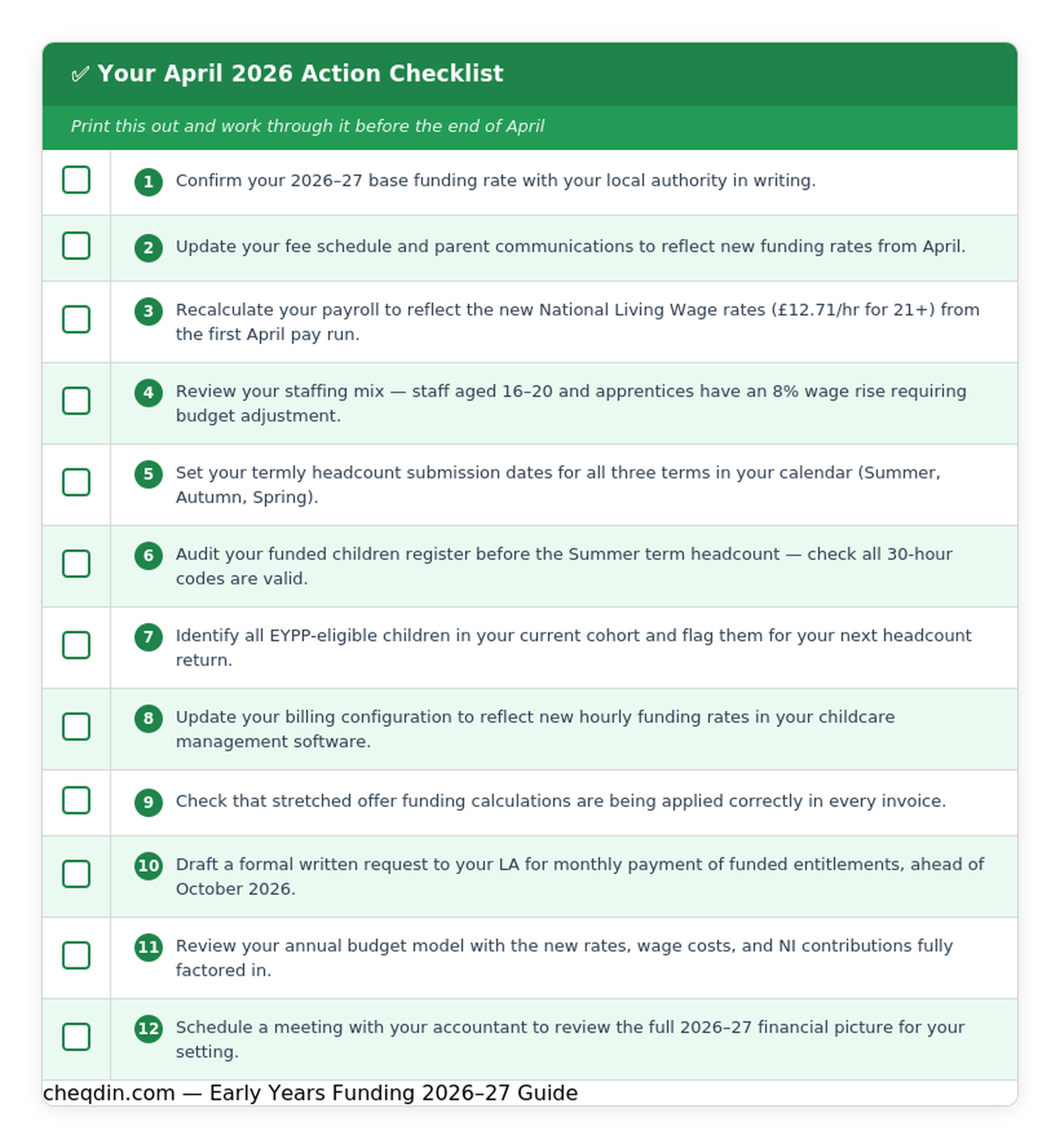
9. Your April 2026 Action Checklist
Use this checklist to make sure your setting has addressed every key change this month:
How Cheqdin Makes Funding Administration Easier
Managing early years funding in 2026 is a multi-layered challenge. Between the new rates, termly headcounts, stretched offer billing, EYPP tracking, and 30-hour code verification, the administrative burden on nursery managers has never been higher.
Cheqdin is built to take that burden off your desk. With automated billing runs, built-in funding deduction rules, attendance reporting for headcount submissions, and direct debit collection via GoCardless, it brings your funding administration and your fee collection into one platform — so nothing gets missed and nothing gets miscalculated.
What Cheqdin providers have access to — at no extra cost:
- - CheqBill: Automated billing with funding deduction rules built in — no manual calculations
- - CheqForm: Digital registration forms that capture funding eligibility at enrolment
- - CheqBook: Flexible session bookings that support both 15-hour and 30-hour entitlements
- - CheqComms: Parent communication tools to send 30-hour code renewal reminders automatically
- - GoCardless direct debit integration for reliable, on-time childcare fee collection
- - Xero integration to keep your accounts reconciled with your funding income
- - Attendance and enrolment reports suitable for termly headcount submissions
If you are currently managing your funded children on spreadsheets or using a billing system not designed for childcare, April 2026 is a sensible moment to review your options. The complexity of the funding landscape is only increasing — and the cost of getting it wrong is real.
Book a free Cheqdin demo: https://go.oncehub.com/cheqdin
Frequently Asked Questions
What are the early years funding rates for 2026–27?
For 2026–27, average national hourly funding rates (paid to local authorities) increase to approximately £10.88/hr for children aged 9 months to 2 years (+4.3%), £8.22/hr for two-year-olds (+4.4%), and £5.95/hr for three and four-year-olds (+4.95%). Your actual rate will vary depending on your local authority’s formula. Contact your LA for your specific base rate and any supplements you are entitled to.
What is the pass-through rate for 2026–27?
From April 2026, local authorities must pass through a minimum of 97% of their early years funding allocation directly to providers. This is an increase from the previous 96% requirement, meaning LAs can now retain a maximum of 3% for central services.
What is the Early Years Pupil Premium rate for 2026–27?
The EYPP rate rises by 15% to £1.15 per hour for 2026–27, equivalent to up to £655 per eligible child per year. Eligible children include those who are looked after, have left care, or whose families meet certain Universal Credit and benefit thresholds.
What is the National Living Wage from April 2026?
The National Living Wage for workers aged 21 and over rises to £12.71 per hour from April 2026 (up from £12.21). The rate for 18–20 year olds rises to £10.40, and the rate for 16–17 year olds and apprentices rises to £8.15 — an 8% increase.
What is the termly headcount change for 2026–27?
From the summer term 2026 onwards, a consistent termly headcount approach applies to three and four-year-old entitlements, aligning them with the existing approach for under-threes. This means providers make three formal headcount returns per year for all funded age groups, and funding is calculated based on actual participation at the start of each term.
When will monthly LA payments for funded entitlements begin?
From October 2026, local authorities will be required to pay providers monthly for funded early education entitlements, if the provider requests this. Providers should make a formal written request to their LA ahead of October to benefit from more regular cash flow.
About Cheqdin Childcare Software
Cheqdin is the UK’s leading SaaS childcare management platform for nurseries, daycares, after-school clubs, and wrap-around care providers. It offers online registrations, flexible bookings, automated billing and invoicing, GoCardless direct debit, and parent communication tools — all in one affordable, easy-to-use platform. Trusted by childcare providers across the UK and Ireland. Rated for best value, ease of use, and customer support on Capterra, GetApp, and Software Advice. Sign up for free here.
Tags
- craft ideas
- gdpr
- childminders
- cyber security measures
- out of school programs
- childminder
- childcare providers
- early years
- childcare legislation
- starting your own childcare business
- nursery management software
- childcare software
- after school clubs
- holiday clubs
- after school club
- safety for children
- staff clock in-out
- eeg
- ofsted
- ofsted going digital
- ofsted inspections
- nursery management
- cheqdin
- marketing tips for out of school clubs
- ways to promote your after school club
- cloud based childcare software
- saas childcare software
- saas solutions for childcare management
- how to increase occupancy rate for nursery
- montessori
- activities for kids
- edible christmas craft ideas
- edible craft ideas
- marshmallow snowman
- pretzel reindeers
- strawberry santa
- business plan templates for nurseries
- cheqxster
- free templates
- menu planning tips
- cloud base childcare software
- out of school clubs
- accident and incident reporting
- reporting injury to ofsted
- billing and invoicing
- grit
- growth mindset
- online safety for children
- business plan for childcare business
- childcare digest
- direct debit
- activity clubs
- coronavirus updates for childcare providers
- online registration
- cheqdin 2.0
- occupancy planner
- online booking
- protips
- how to increase the occupancy of your childcare centre
- sensory play
- scaffolding
- creche management software
- mental health
- climate change
- childcare
- ncs and ecce
- childcare funding
- ireland
- united kingdom
- united states
- ai
- guides
- uk
- childcare uk