

The Employment Rights Act 2025: What Every Nursery Employer Needs to Know

If you employ staff in a nursery, daycare or after-school club, 2026 is the year UK employment law changed beneath your feet. The Employment Rights Act 2025 described by the Government as the most significant upgrade to workers’ rights in a generation began rolling out its first major wave of changes on 6 April 2026, with more to come through 2026 and into 2027.
For the childcare sector, this matters more than for most industries. Nurseries are people businesses: wages typically account for 70–80% of operating costs, and settings often employ a higher-than-average proportion of part-time, younger, and apprentice staff. Many of the new rights, particularly around sick pay and family leave, land hardest exactly where childcare settings are most exposed.
This guide walks through every change that affects nursery employers, what it means in practice, and the steps to take now to stay compliant. It is written for busy nursery owners and managers not employment lawyers, so we’ve kept the legalese to a minimum.
⚠️ Important
This article is a general guide, not legal advice. Employment law is complex and the details of your obligations depend on your specific circumstances. For decisions affecting individual staff members, always consult a qualified employment law adviser or your HR provider.
1. The Big Picture: What’s Changing and When
The Employment Rights Act introduces changes across more than 28 areas of employment law. Rather than arriving all at once, they are being phased in over two years. Here are the milestones that matter most for nursery employers:
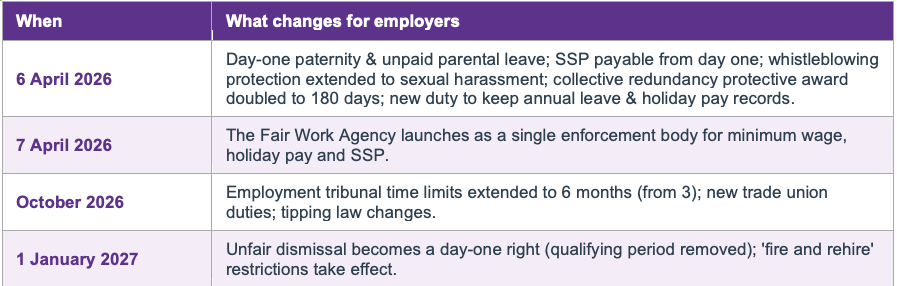
The most immediate impact comes from the April 2026 changes so that is where most of this guide focuses. But it is worth keeping the 2027 changes (particularly day-one unfair dismissal rights) on your radar now, because they will affect how you recruit and manage probation periods later this year.
2. Day-One Family Leave Rights
Previously, staff had to accumulate a qualifying period of service before they could take certain types of family leave. From 6 April 2026, that requirement has gone for two key entitlements.
Paternity leave and unpaid parental leave are now day-one rights
Both statutory paternity leave and unpaid parental leave became day-one rights on 6 April 2026 meaning a new employee can request them from their very first day, rather than waiting months to qualify. Employees can also now take paternity leave either before or after a period of shared parental leave.
For nurseries, which often recruit throughout the year and may take on staff who are themselves new or expecting parents, this means you should be prepared for leave requests far earlier in the employment relationship than before. Your onboarding process and staff handbook should reflect the new entitlements.
New: bereaved partner’s paternity leave
A new entitlement also came into force on 6 April 2026: a bereaved partner, the surviving partner of someone who dies in connection with childbirth is entitled to up to 52 weeks of leave, available regardless of length of service. While this is, thankfully, a situation most settings will rarely encounter, your policies should acknowledge it so that managers know how to respond compassionately and correctly if it arises.
3. The Statutory Sick Pay Overhaul: The Biggest Cost Impact
Of all the April 2026 changes, the reform of Statutory Sick Pay (SSP) is likely to have the most direct financial impact on nurseries, because it changes both who qualifies and from when.
Two fundamental changes
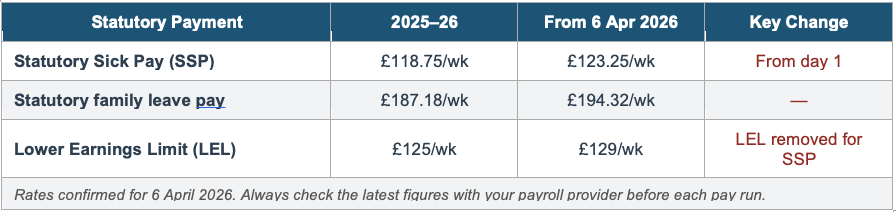
- The three “waiting days” are abolished. Previously, SSP was not payable for the first three days of sickness absence. From 6 April 2026, SSP is payable from the very first day of absence.
- The Lower Earnings Limit threshold is removed. Previously, employees earning below a set threshold did not qualify for SSP at all. Now, SSP is available to all employees regardless of earnings level. Employees whose average weekly earnings fall below the Lower Earnings Limit (£129 from 6 April 2026) receive SSP at 80% of their average weekly earnings, or the flat rate, whichever is lower.
Why this hits nurseries specifically
Childcare settings employ many part-time and lower-paid staff who, under the old rules, often did not qualify for SSP, or only triggered it after several days. Under the new rules, far more of your team will be entitled to SSP and from day one of any absence. In a sector where short-term illness is common (early years staff are exposed to every cold and bug going round the setting), this represents a real and recurring new cost.
In practical terms: sickness absence that previously cost you nothing in statutory pay will now carry a cost from the first day. This is not a reason to discourage staff from taking sick leave when they need it — but it is a cost you need to budget for and a reason to have robust, fair absence recording in place. Accurate records of who was absent, when, and for how long are now more important than ever.
💰 Budget for this now
Model the likely cost of day-one SSP across your team for the year ahead. If you have, say, 15 staff and assume an average of five sick days each per year that previously fell within waiting days or below the earnings threshold, the new entitlement could add a four-figure sum to your annual wage bill. Factor this into your 2026–27 budget alongside the funding and minimum wage changes from April.
4. New Duty: Keeping Annual Leave and Holiday Pay Records
A change that has flown somewhat under the radar but which directly affects every nursery’s admin — is the new requirement, in force from 6 April 2026, for employers to keep records of annual leave and holiday pay.
This formalises what good employers were already doing, but it raises the stakes: holiday and leave records are now a compliance matter, not just good practice. With the new Fair Work Agency empowered to enforce holiday pay (more on that below), settings that rely on memory, scattered spreadsheets, or paper request forms are exposed to real risk.
What good record-keeping looks like
- A clear, central record of each staff member’s annual leave entitlement, days taken, and days remaining
- Dated records of leave requests and approvals
- Accurate calculation of holiday pay, including for part-time and variable-hours staff (a common area of error in the sector)
- Records that can be produced quickly if requested by the Fair Work Agency or in an employment tribunal
This is one area where childcare management software earns its keep. Rather than chasing paper forms or maintaining a fragile spreadsheet, a system that tracks staff leave alongside your rota gives you an accurate, always-current record — and removes a genuine compliance risk from your desk.
💡 How Cheqdin helps
Cheqdin’s staff management tools let you record staff details, track absence and leave, and keep a clear record of your compliance checks in one secure place. Rather than storing sensitive documents themselves, Cheqdin records that a check has been completed — for example, a tick to confirm a DBS check is in place, along with the date it was carried out — and lets you set reminders for items that expire, such as right-to-work checks and health and safety or first aid training. When you need to evidence leave records or check who was on shift on a given day, the information is there in a few clicks rather than buried in a filing cabinet. Note: Cheqdin supports your record-keeping and staff admin — it does not replace your payroll provider, who will handle the actual SSP and statutory payment calculations.
5. Stronger Protections Around Harassment and Whistleblowing
From 6 April 2026, a worker who discloses information about sexual harassment in the reasonable belief that it is in the public interest — is entitled to the full suite of whistleblowing protections. This means staff who report sexual harassment, whether of themselves or others, are protected from dismissal and detriment for having raised it.
For nurseries, this reinforces the importance of having clear, accessible policies for raising concerns, and a culture where staff feel safe to speak up. It sits alongside the sector’s existing, and rightly stringent, safeguarding culture. Settings should review their whistleblowing and anti-harassment policies to ensure they reflect the strengthened legal position, and that all staff know how to raise a concern and what protection they have when they do.
Looking ahead, further duties on employers to take “all reasonable steps” to prevent sexual harassment — including harassment by third parties such as parents or visitors — are expected later. Getting your policies and training in good order now will leave you well prepared.
6. Collective Redundancy: Higher Stakes for Larger Groups
From 6 April 2026, the maximum “protective award” a tribunal can order where an employer fails to comply with collective consultation requirements has doubled from 90 days’ pay to 180 days’ pay per affected employee.
Collective consultation obligations currently apply where an employer proposes to dismiss 20 or more employees at one establishment within 90 days. For most single-site nurseries this threshold will rarely be reached. However, for nursery groups and multi-site operators, the doubling of the penalty significantly raises the financial risk of getting redundancy consultation wrong. If your group is contemplating restructuring or closures, take advice early and follow the consultation process meticulously.
7. The Fair Work Agency: A New Enforcement Body
On 7 April 2026, the Fair Work Agency launched as a single body to enforce key statutory rights bringing together minimum wage enforcement, holiday pay, and statutory sick pay under one roof.
Crucially, the agency has powers to conduct proactive investigations without waiting for a worker to complain. This is a meaningful shift. Previously, many compliance failures only came to light when an employee raised a grievance or tribunal claim. Now, settings could face scrutiny without any individual complaint having been made.
The practical takeaway: the days of “we’ll sort the paperwork if anyone ever asks” are over. Minimum wage compliance, accurate holiday pay, and proper SSP administration all need to be right, consistently, and evidenced. Combined with the new record-keeping duty, this makes well-organised staff records a genuine compliance priority for 2026.
⚠️ Minimum wage: a common nursery pitfall
Remember that minimum wage compliance is checked per pay reference period, not annually. Watch out for hidden traps: time spent in training, handovers, or staff meetings counts as working time; and deductions for uniforms or required items can pull effective pay below the legal minimum even when the headline rate looks fine. With the April 2026 rates now at £12.71 (21+), £10.85 (18–20) and £8.00 (16–17 and apprentices), check that every staff member — especially apprentices who have passed their first year is on the correct rate for their age and status.
8. What’s Coming Next: Plan for 2027 Now
Several of the most significant changes take effect from 1 January 2027, but they will affect decisions you make in 2026, so they belong on your radar today.
Unfair dismissal becomes a day-one right
From 1 January 2027, the qualifying period for ordinary unfair dismissal protection is removed, making it a day-one right. Importantly, this will apply to employees already in post on that date — meaning anyone you hire from around the end of June 2026 onwards will likely have full unfair dismissal protection by January 2027.
The practical implication: your recruitment, induction, and probationary processes need to be robust now. Where previously you had a window to assess a new hire’s suitability with limited dismissal risk, that window is closing. Make sure job descriptions are clear, probation reviews are structured and documented, and any performance concerns are raised and recorded early and fairly.
“Fire and rehire” restrictions
Also from January 2027, new restrictions on dismissing and re-engaging staff on changed terms (“fire and rehire”) take effect. If you anticipate needing to change staff terms and conditions, seek advice well ahead of time.
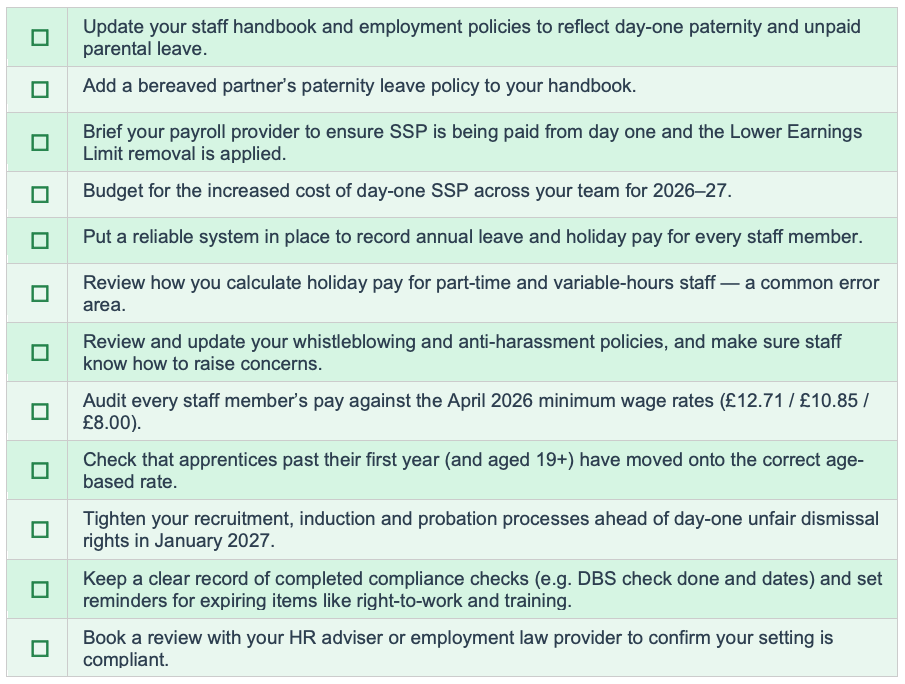
9. Your Nursery Employer Action Checklist
Work through this checklist to make sure your setting is on top of the 2026 changes:
How Cheqdin Supports Your Staff Admin and Compliance
The 2026 employment law changes share a common thread: accurate, accessible records matter more than ever. Whether it’s leave and holiday records, staff documentation, or knowing exactly who was on shift on any given day, settings that keep this information organised will find compliance far less stressful — and will be ready if the Fair Work Agency ever comes knocking.
Cheqdin brings your childcare operations and your staff admin into one platform. Alongside online registrations, bookings, billing and parent communication, Cheqdin helps you keep staff records, track absence and leave, manage rotas, and store key documents securely.
What Cheqdin helps you manage:
- - Centralised staff records, including contact details and qualifications
- - A record of completed compliance checks, e.g. confirming a DBS check is in place and when it was done (not the certificate itself)
- - Reminders for expiring items such as right-to-work checks and health and safety or first aid training
- - Staff absence and leave tracking, kept alongside your rota
- - Staff scheduling and attendance, so you always know who was on shift
- - Parent communication, billing and registrations; your whole setting in one place
- - Cheqdin supports your record-keeping and day-to-day staff administration. It is not a payroll system or a substitute for professional HR and legal advice but it removes much of the admin burden that makes compliance feel overwhelming, so you can focus on running a great setting.
Book a free Cheqdin demo: cheqdin.com/demo
Frequently Asked Questions
When did the Employment Rights Act 2025 changes come into effect?
The first major wave of changes came into force on 6 April 2026, including day-one paternity and unpaid parental leave, Statutory Sick Pay from day one, strengthened whistleblowing protections, and a new duty to keep annual leave and holiday pay records. The Fair Work Agency launched on 7 April 2026. Further changes follow in October 2026 and January 2027.
Do nursery staff now get sick pay from day one?
Yes. From 6 April 2026, the three “waiting days” for Statutory Sick Pay were abolished, so SSP is payable from the first day of absence. The Lower Earnings Limit was also removed, meaning SSP is now available to all employees regardless of earnings, with those earning below the threshold receiving 80% of their average weekly earnings or the flat rate, whichever is lower.
What are the minimum wage rates for nurseries from April 2026?
From 1 April 2026: £12.71 per hour for workers aged 21 and over (National Living Wage), £10.85 for 18–20 year olds, and £8.00 for 16–17 year olds and apprentices. Apprentices aged 19 or over who have completed their first year must move onto the standard rate for their age.
What records do nursery employers now have to keep?
From 6 April 2026, employers must keep records of annual leave and holiday pay. In practice this means maintaining accurate, accessible records of each staff member’s leave entitlement, leave taken, and holiday pay calculations — records you can produce if requested by the Fair Work Agency or in a tribunal.
When does unfair dismissal become a day-one right?
From 1 January 2027, the qualifying period for unfair dismissal protection is removed, making it a day-one right. This will apply to employees already in post on that date, so anyone hired from around the end of June 2026 onwards is likely to be protected by January 2027. Nursery employers should strengthen their recruitment, induction and probation processes now.
Does Cheqdin handle payroll and SSP calculations?
No. Cheqdin is a childcare management platform that supports your staff record-keeping, leave tracking, compliance-check records and rota management. The actual calculation and payment of SSP and other statutory payments is handled by your payroll provider. Cheqdin helps you keep the underlying records accurate and accessible — including reminders for expiring checks such as right-to-work and training.
About Cheqdin
Cheqdin is the UK’s leading SaaS childcare management platform for nurseries, daycares, after-school clubs, and wrap-around care providers. It offers online registrations, flexible bookings, automated billing and invoicing, GoCardless direct debit, staff management, and parent communication tools — all in one affordable, easy-to-use platform. Trusted by childcare providers across the UK and Ireland. Try Cheqdin for free.
Tags
- craft ideas
- gdpr
- childminders
- cyber security measures
- out of school programs
- childminder
- childcare providers
- early years
- childcare legislation
- starting your own childcare business
- nursery management software
- childcare software
- after school clubs
- holiday clubs
- after school club
- safety for children
- staff clock in-out
- eeg
- ofsted
- ofsted going digital
- ofsted inspections
- nursery management
- cheqdin
- marketing tips for out of school clubs
- ways to promote your after school club
- cloud based childcare software
- saas childcare software
- saas solutions for childcare management
- how to increase occupancy rate for nursery
- montessori
- activities for kids
- edible christmas craft ideas
- edible craft ideas
- marshmallow snowman
- pretzel reindeers
- strawberry santa
- business plan templates for nurseries
- cheqxster
- free templates
- menu planning tips
- cloud base childcare software
- out of school clubs
- accident and incident reporting
- reporting injury to ofsted
- billing and invoicing
- grit
- growth mindset
- online safety for children
- business plan for childcare business
- childcare digest
- direct debit
- activity clubs
- coronavirus updates for childcare providers
- online registration
- cheqdin 2.0
- occupancy planner
- online booking
- protips
- how to increase the occupancy of your childcare centre
- sensory play
- scaffolding
- creche management software
- mental health
- climate change
- childcare
- ncs and ecce
- childcare funding
- ireland
- united kingdom
- united states
- ai
- guides
- uk
- childcare uk