

The New Ofsted Report Cards Explained: How to Get Your Nursery Inspection-Ready

The way Ofsted inspects nurseries has changed more in the past year than in the previous decade. Since the renewed Education Inspection Framework came into effect on 10 November 2025, the familiar single-word judgements: Outstanding, Good, Requires Improvement, Inadequate are no longer used. In their place is a new report card, a five-point grading scale applied to each area of your provision, and a standalone judgement on inclusion.
And the changes keep coming. On 12 June 2026, Ofsted published its annual update to the Early Years Inspection Toolkit, with a set of new standards that take effect for all nursery inspections from September 2026. If your setting is due an inspection this year, understanding both the framework and the latest toolkit update is essential.
This guide explains, in plain English, what the new report cards mean, how the grading works, what inspectors are looking at, and — most importantly — the practical steps you can take now to feel confident and prepared, whenever your call comes.
📅 When does all this apply to my setting?
- - The renewed framework has applied to all inspections since 10 November 2025.
- - Your setting moves to the new report-card style at your next inspection under the framework earlier reports stay viewable for reference.
- - The June 2026 toolkit update takes effect from September 2026. Until then, inspectors use the existing materials.
1. What’s Changed at a Glance
If you only take away the headlines, these are the shifts that matter most for nurseries and childminders:
- - Report cards replace single-word grades. There is no longer one overall “Outstanding” or “Good” label for your whole setting.
- - A five-point grading scale is applied to each evaluation area separately, so your report card can show different grades across different areas.
- - Safeguarding is judged separately as “Met” or “Not met”, sitting outside the grading scale.
- - Inclusion is now a standalone evaluation area, with a specific focus on children with SEND and those facing disadvantage.
- - Staff well-being is formally assessed within Leadership and governance, a genuinely new expectation.
- - The inspection cycle shortens from six years to four from April 2026, so you can expect to see inspectors more often.
- - The updated toolkit from September 2026 makes meeting EYFS statutory requirements a baseline for reaching the expected standard.
2. Report Cards and the Five-Point Grading Scale
The single biggest change is the move from one overall judgement to a report card that grades each area of your provision individually. The idea is to give parents and providers a more nuanced picture: a setting might have outstanding leadership but a specific area that needs development, and the report card now shows that clearly rather than collapsing everything into one word.
Each evaluation area receives one of five grades, colour-coded for clarity:
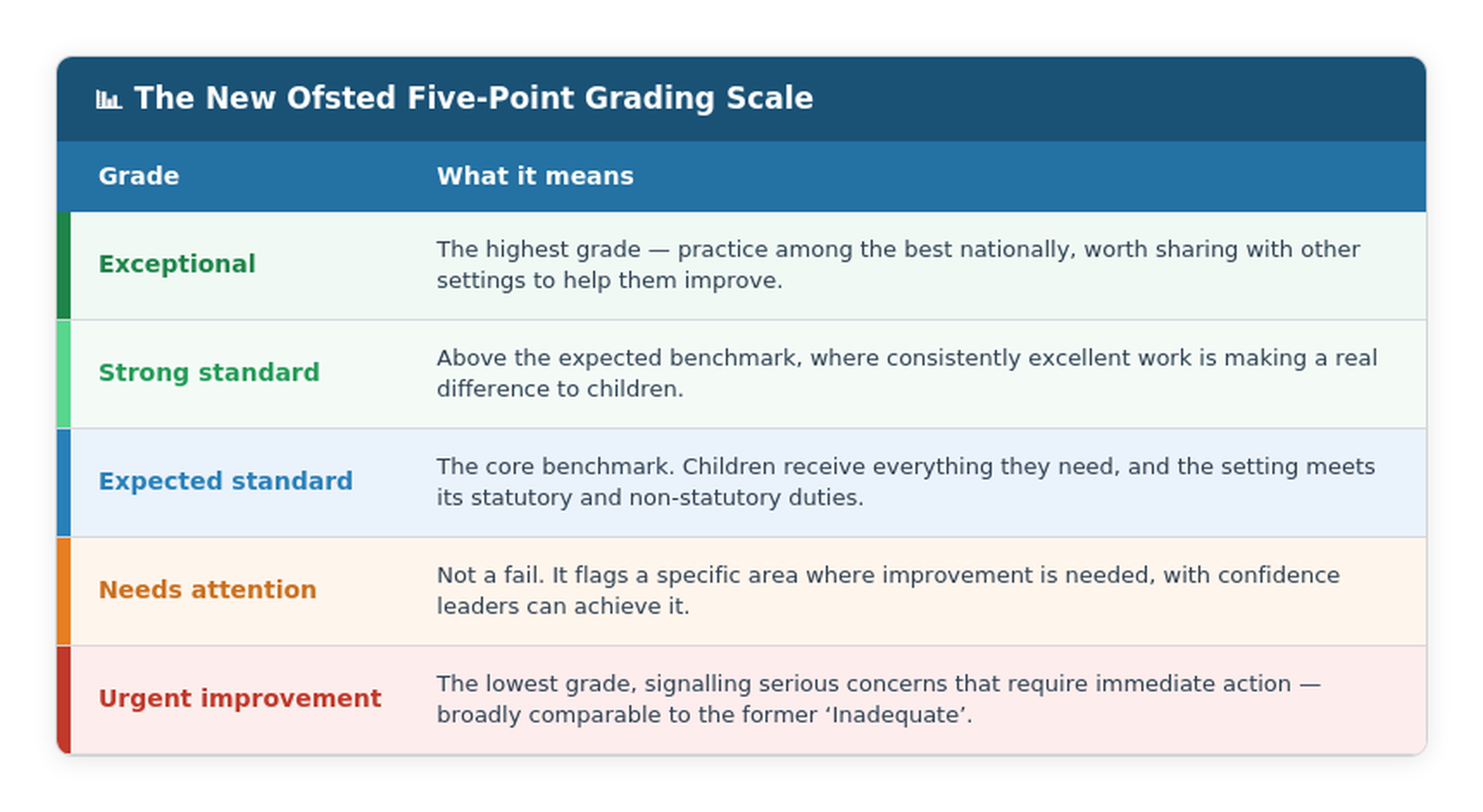
A crucial point: the “expected standard” is a genuine benchmark, not a starting point. To achieve it, a setting must meet all the criteria set out in the toolkit for that area, inspectors no longer have discretion to award a grade simply because a setting broadly aligns with the overall description. Chief Inspector Sir Martyn Oliver has indicated that the expected standard is where most settings are likely to sit, and reaching it is an achievement in its own right.
Ofsted has also been explicit that the new grades cannot be mapped back onto the old four-point scale. “Expected standard” does not equal “Good”, and trying to translate between the two is misleading. Parents are encouraged to read the narrative descriptions on the report card, not just the labels.
3. The Early Years Evaluation Areas
The framework streamlines what inspectors evaluate and aligns it more closely with the statutory Early Years Foundation Stage (EYFS). For early years settings, these are the evaluation areas that appear on your report card, each receiving one of the five grades:
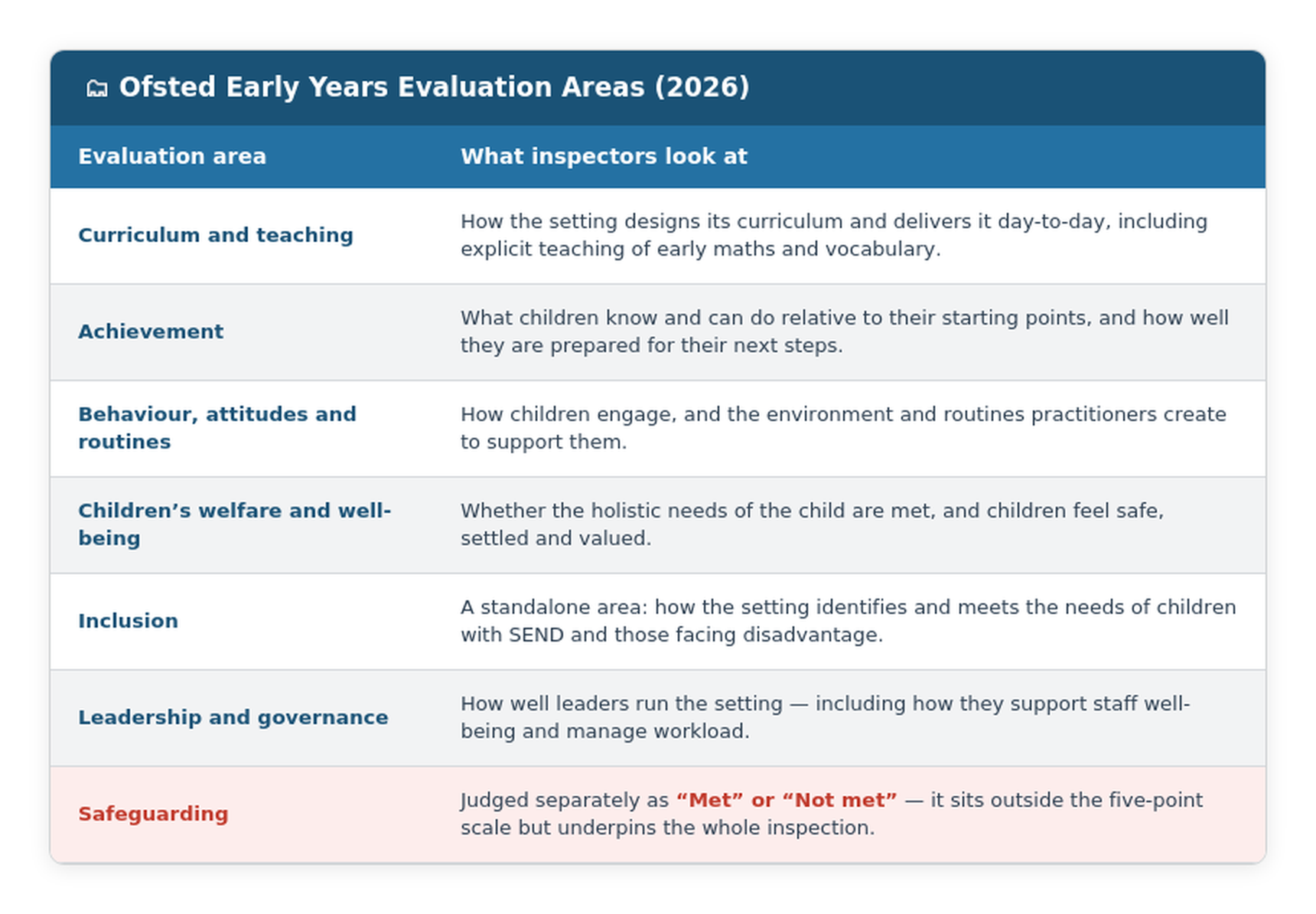
You may notice the familiar “three I’s”, intent, implementation and impact are no longer set out as formal subheadings. The thinking behind them still underpins how inspectors gather evidence, particularly within curriculum and teaching, but the language is now more contextual. On the day, your role is to help the inspector see first-hand the intent behind your decisions, how they work in practice, and the difference they make for children.
4. Safeguarding: Judged Separately, Underpinning Everything
Under the new framework, safeguarding is judged as either “Met” or “Not met”, it sits outside the five-point scale, but it remains the thread running through every inspection activity. A “Not met” judgement on safeguarding is one of the most serious outcomes a setting can receive.
Inspectors assess safeguarding by looking at compliance, preparation, staff awareness, and the everyday culture of your setting, not just your written policies. They want to see that a positive, open safeguarding culture is genuinely embedded. In practical terms, they will expect quick, easy access to your safeguarding and child protection procedures, your whistleblowing procedure, and your records of concerns, referrals and follow-up.
Importantly, child attendance is part of the safeguarding picture. Inspectors look not only at whether attendance is recorded, but at the processes you have in place when a child’s absence causes concern. Being able to show, quickly, how you track attendance and follow up on unexplained absences is exactly the kind of evidence that makes these conversations run smoothly.
💡 Where Cheqdin helps on inspection day
Ofsted is clear that you don’t need to create special paperwork for inspection, records simply need to be accurate and easily accessible. This is where a childcare management platform earns its place. With Cheqdin, your child attendance records and absence follow-up are in one place, so if an inspector asks how you monitor attendance and respond to unexplained absences, you can show them in seconds rather than digging through paper registers. It’s a small thing that makes the safeguarding conversation far less stressful.
5. A Shorter Inspection Cycle: What to Expect
From April 2026, the routine inspection cycle for registered early years providers shortened from six years to four. Alongside this:
- - New providers will now be inspected within 12 to 18 months of registration, much sooner than the previous wait of up to 30 months.
- - Every setting on the Early Years Register will be inspected at least once by March 2030.
- - If you were last inspected under the old six-year window, you will move to the new four-year window at your next routine inspection.
The practical implication is simple: inspection is now a more regular feature of running a setting, not a once-in-a-blue-moon event. That makes ongoing readiness, rather than a frantic scramble when the call comes; the sensible approach. Settings that keep their records, staff documentation and self-evaluation continuously up to date will find each inspection far less daunting.
6. How Inspections Now Run
The tone and mechanics of inspection have shifted towards what Ofsted describes as a “done with, not done to” approach more collaborative, more conversational, and more focused on everyday practice than on documentation.
The planning call
The traditional “learning walk” has been replaced by a planning call the day before your inspection. On this call, you’ll talk through a self-reflection of your setting using the Early Years Inspection Toolkit. This conversation shapes the areas the inspector focuses on, so it’s worth preparing for — though the aim is a genuine professional dialogue, not a rehearsed performance.
Evidence through conversation and observation
Throughout the inspection day, inspectors gather most of their evidence through informal professional conversations with your team and by observing day-to-day practice. They’ll want to see what it’s like to be a child in your setting; whether children are happy, settled, curious, and well-bonded with their key people.
Staff well-being is now part of the picture
A genuinely new element: inspectors will ask your practitioners whether they feel supported and how workload is managed, and will check in on you as the nominated individual too. A sustainable, supportive working culture is now something Ofsted actively looks for within Leadership and governance.
✅ You do NOT need to create paperwork for inspection
Ofsted states plainly that inspectors do not need information presented in any particular format, and that leaders should not produce documents specially for inspection that only creates unnecessary workload. The test is simply that your records are accurate and easily accessible. If preparing for inspection means creating new reports, your systems are working against you; the right tools make your everyday work visible without extra effort.
7. What’s New in the June 2026 Toolkit Update
On 12 June 2026, Ofsted published its first annual update to the Early Years Inspection Toolkit, operating guide and inspection information. These changes take effect from September 2026 — until then, inspectors continue to use the existing materials. Going forward, Ofsted will refresh these documents each year, publishing changes in advance to take effect each September. Here’s what’s changing:
A new EYFS baseline for the expected standard
The most significant structural change: relevant EYFS statutory requirements must be fully met as a baseline before a setting can achieve the “expected standard” in any evaluation area. In other words, meeting your statutory duties is now the floor you must clear before higher grades are even in play.
Safer sleeping, eating and allergy management
Following new DfE guidance published on 20 April 2026, updated statutory requirements on safe sleeping arrangements, weaning, safer eating and allergy management have been woven across several sections of the toolkit, including safeguarding and welfare. Settings should review their practice in these areas well before September. Being able to see every child’s dietary requirements and allergies at a glance rather than relying on memory or scattered paper notes is exactly the kind of practical safeguard this update points towards; a health dashboard that consolidates this information supports both daily practice and the evidence you can show an inspector.
Sharper focus on evidenced impact for vulnerable children
Paragraphs describing how inspectors evaluate settings with no currently enrolled disadvantaged children have been removed. The higher-grade descriptors now lean heavily on demonstrated, evidenced impact on vulnerable groups — children with SEND, those facing disadvantage, and those known or previously known to children’s social care.
Safeguarding evidence and curriculum clarifications
The toolkit expands the criteria inspectors use to evaluate how leaders gather and share safeguarding information, and for the first time links directly to Ofsted’s supporting evidence and research base. There are also clarifications on curriculum and teaching, with an explicit focus on developing English vocabulary and age-appropriate early maths, including direct teaching of mathematics rather than relying on play alone.
⚠️ Action before September 2026
Read Ofsted’s published summary of changes to the toolkit, review your safe sleeping, weaning and allergy management practice against the new DfE guidance, and check that your EYFS statutory compliance is watertight; it is now the baseline for every grade above ‘needs attention’.
8. Inspection-Ready Records: What Inspectors Want to See Quickly
While inspection is now less about paperwork and more about practice, there are still records inspectors will want easy access to — particularly around staff suitability and safeguarding, which they typically sample early in the visit. Being able to produce these without fuss sets a confident tone for the whole inspection.
Inspectors will usually want quick access to:
- - Evidence that staff are suitable for their roles: qualifications, training, and required checks
- - A record of DBS and barred-list checks, plus identity and vetting checks including what was checked, by whom, and when
- - Recruitment and suitability checks for each staff member
- - Induction records for new staff and apprentices
- - Paediatric first aid certificates, and how you ensure first aid cover whenever children are present
- - Child attendance records, and your processes for following up absences that cause concern
- - Accident and incident records, showing how events are logged and how parents are informed
- - Safeguarding, child protection and whistleblowing policies and procedures
Notice how many of these are operational records rather than curriculum documents. This is precisely the territory where a well-organised childcare management system removes stress — keeping the fact and dates of your checks, your attendance data, and your staff records in one accessible place.
💡 How Cheqdin supports inspection readiness
- - Child attendance records and absence follow-up, ready to show as part of the safeguarding conversation
- - Staff clock in and out and rota management, giving you an accurate, real-time record of who was on site and when — useful evidence for both suitability and ratios
- - Accident and incident reporting, with an auto-acknowledgement feature so parents are notified and their acknowledgement is logged — a clear, dated audit trail of how incidents are recorded and communicated
- - A health dashboard bringing children’s dietary requirements, allergies and key health information together in a single view — directly relevant to the toolkit’s new focus on safer eating and allergy management
- - A clear record that staff compliance checks are complete — for example, confirming a DBS check is in place and when it was done (Cheqdin records the check, not the certificate or any criminal-record data)
- - Reminders for expiring items such as paediatric first aid, right-to-work and training so nothing lapses before an inspection
- - Centralised staff records covering qualifications and key details
- - Parent communication and registrations kept in one place, so information is easy to find on the day
A note on scope: Cheqdin supports the operational, attendance and staff-records side of inspection readiness. It is not an EYFS curriculum or learning-journal tool — the curriculum and teaching evidence inspectors gather comes from your practice and professional dialogue, not from software. What Cheqdin does is take the administrative weight off your shoulders so you can focus on exactly that.
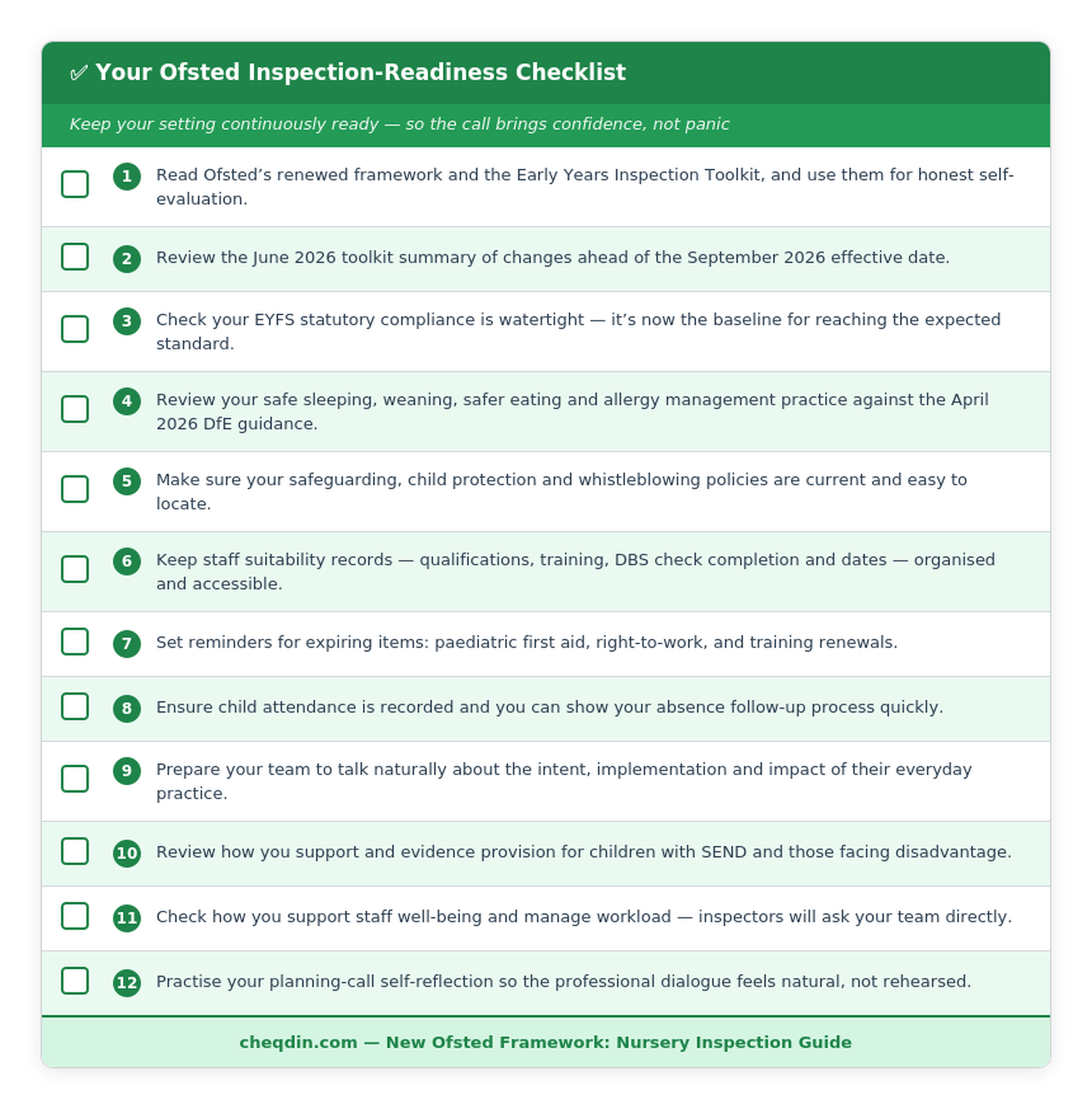
9. Your Inspection-Readiness Checklist
Use this checklist to keep your setting continuously ready so an inspection call brings confidence rather than panic:
Face Your Next Inspection with Confidence
The renewed Ofsted framework asks a lot of nursery leaders but at its heart, the message is reassuring: inspection is less about producing perfect paperwork and more about showing the genuine, everyday quality of care and education children receive. The settings that cope best are those that stay continuously ready, with their records organised and their practice strong, rather than scrambling when the call comes.
Cheqdin helps you carry that administrative load. By keeping your attendance records, staff suitability information, compliance-check reminders and parent communications in one accessible platform, it means the operational side of inspection readiness is always in order — freeing you to focus on your children, your team, and the professional conversations that now sit at the centre of inspection.
Book a free Cheqdin demo: cheqdin.com/pricing
Frequently Asked Questions
When did the new Ofsted framework come into effect?
The renewed Education Inspection Framework was published on 9 September 2025 and came into effect for inspections from 10 November 2025. Your setting moves to the new report-card style at its next inspection under the framework. A further update to the Early Years Inspection Toolkit was published on 12 June 2026 and takes effect from September 2026.
What are the new Ofsted grades for nurseries?
Each evaluation area is graded on a five-point scale: Urgent improvement, Needs attention, Expected standard, Strong standard, and Exceptional. The expected standard is the core benchmark. Safeguarding is judged separately as “Met” or “Not met” and sits outside this scale. Grades apply to individual areas, so a report card can show a mix of grades.
Can the new grades be compared to Outstanding or Good?
No. Ofsted has been explicit that the new five-point grades cannot be mapped back onto the old four-point scale. “Expected standard” does not equal “Good”. Parents are encouraged to read the narrative descriptions on the report card rather than trying to translate between the old and new systems.
How often will my nursery be inspected now?
From April 2026, the routine inspection cycle shortened from six years to four. New providers are inspected within 12 to 18 months of registration, and all settings on the Early Years Register will be inspected at least once by March 2030. If you were last inspected under the six-year window, you move to the four-year window at your next routine inspection.
What documents does Ofsted want to see during an early years inspection?
Inspectors typically sample staff suitability and safeguarding records early. They’ll want easy access to evidence of staff qualifications and checks, DBS and vetting records (including what was checked, by whom and when), recruitment and induction records, paediatric first aid certificates, child attendance records, and your safeguarding, child protection and whistleblowing procedures. You don’t need to create anything specially — records just need to be accurate and easily accessible.
Does Cheqdin help with Ofsted inspections?
Cheqdin supports the operational and records side of inspection readiness; child attendance and absence follow-up, staff clock in/out and rota, accident and incident reporting with auto-acknowledgement to parents, a health dashboard for children’s dietary requirements and allergies, staff suitability records, and compliance-check reminders (such as first aid and right-to-work). It records that checks like DBS have been completed and when, rather than storing sensitive certificates themselves. Cheqdin is not an EYFS curriculum tool; the curriculum and teaching evidence comes from your everyday practice and professional dialogue with inspectors.
For the official guidance from Ofsted on Understanding Ofsted report cards and grades, visit the Ofsted Guidance page.
About Cheqdin
Cheqdin is the UK’s leading SaaS childcare management platform for nurseries, daycares, after-school clubs, and wrap-around care providers. It offers online registrations, flexible bookings, automated billing and invoicing, GoCardless direct debit, staff management, and parent communication tools — all in one affordable, easy-to-use platform. Trusted by childcare providers across the UK and Ireland. Sign up for free!
Tags
- craft ideas
- gdpr
- childminders
- cyber security measures
- out of school programs
- childminder
- childcare providers
- early years
- childcare legislation
- starting your own childcare business
- nursery management software
- childcare software
- after school clubs
- holiday clubs
- after school club
- safety for children
- staff clock in-out
- eeg
- ofsted
- ofsted going digital
- ofsted inspections
- nursery management
- cheqdin
- marketing tips for out of school clubs
- ways to promote your after school club
- cloud based childcare software
- saas childcare software
- saas solutions for childcare management
- how to increase occupancy rate for nursery
- montessori
- activities for kids
- edible christmas craft ideas
- edible craft ideas
- marshmallow snowman
- pretzel reindeers
- strawberry santa
- business plan templates for nurseries
- cheqxster
- free templates
- menu planning tips
- cloud base childcare software
- out of school clubs
- accident and incident reporting
- reporting injury to ofsted
- billing and invoicing
- grit
- growth mindset
- online safety for children
- business plan for childcare business
- childcare digest
- direct debit
- activity clubs
- coronavirus updates for childcare providers
- online registration
- cheqdin 2.0
- occupancy planner
- online booking
- protips
- how to increase the occupancy of your childcare centre
- sensory play
- scaffolding
- creche management software
- mental health
- climate change
- childcare
- ncs and ecce
- childcare funding
- ireland
- united kingdom
- united states
- ai
- guides
- uk
- childcare uk